
Our Art and Design Curriculum
Intent
At Delph Primary School, we value Art and Design as an important part of the children’s entitlement to a broad and balanced curriculum and believe that a high quality art education shapes well rounded and confident individuals. Alongside literacy and numeracy, creativity is another skill needed in our workforce today and because of this, our aim is to provide pupils at Delph Primary with unique, holistic opportunities to unlock their innate creativity and develop their creative competence through artistic expression. In order to do this, we plan for and deliver experiences which allow our pupils to learn a collection of skills; develop their proficiency to use a range of media; and learn about significant artists and art movements, whilst subsequently developing their design skills and extending their vocabulary by expressing their individual interests, thoughts and ideas. At Delph Primary, we pride ourselves in providing all pupils with inclusive, accessible learning experiences in every area of the curriculum and this is especially evident in our art curriculum due to the very nature of the subject.
Art and Design is a natural form of expression and source of great pleasure for most pupils. As a school, we encourage our pupils to have a growth mind-set in all curriculum areas as it promotes a positive learning attitude. We feel this approach to learning is particularly important during our art lessons as exploration is encouraged and mistakes are reflected upon consistently as we perceive them as important parts of the learning journey. This learning journey is evident in the children’s sketchbooks; a space where they can take risks and explore creatively and critically.
At Delph Primary, we provide a caring and supportive environment to ensure that every child has the opportunity to reach their full potential. We are committed to providing all children with learning opportunities to engage in Art and Design and every child in our school will have full access to this as set out in the National Curriculum and regardless of age, gender or ability.
Implementation
The children’s journey as artists starts in Foundation Stage where they progress through the EYFS curriculum with Expressive Arts and Design and on to the National Curriculum in Key Stage One and Two. Art days and art weeks are often embedded within topics but can also be delivered discretely. These themed days/weeks allow the children to work both independently and collaboratively and become fully immersed in a variety of high quality creative activities where they get the opportunity to develop their skills and express their creative ideas in a supportive and inclusive environment. In recent years, these art days/weeks have also included visits from local artists to help inspire and enthuse the children about the subject. The children are also given the valuable opportunity to visit local galleries as we feel this experience contributes to a high quality cultural education and teaches them the aspirational aspect of the subject.
The children are taught a variety of techniques and given a range of materials and tools which they are then encouraged to explore in their sketchbooks. Class sketchbooks are also used for collaborative work and to record a variety of finished pieces. This is clearly set out in our Progression Grids, which has been carefully structured to allow lots of opportunities for children to practise and embed key skills and concepts.
A strong focus for teaching is the use of correct technical vocabulary. Teachers carefully plan the language they use during their sessions and model, through discussion and subject specific vocabulary to help embed this language in the children’s long term memory. This is also reinforced through the use of sticky knowledge splats/grids and lesson specific word banks which support the children to appraise their own work and respond to the work of others.
Aims
The national curriculum for Art and Design aims to ensure that all pupils:
1. Produce creative work, exploring their ideas and recording their experiences.
2. Become proficient in drawing, painting, sculpture and other art, craft and design techniques.
3. Evaluate and analyse creative works using the language of art, craft and design.
4. Know about great artists, craft makers and designers, and understand the historical and cultural development of their art forms.
EYFS
Through Expressive Arts children are encouraged to explore different media, explore how media can be combined to create different effects and develop a range of skills and techniques experimenting with colour, design, texture, form and function. Children are given daily access to a range of creative opportunities and enjoy our carefully planned and well-resourced creative areas both indoors and out. Children are encouraged to create on both small and large scales and our outdoor environment supports this well. Children are encouraged to develop their communication and language skills through talking about their creations and sharing these with others to build confidence and raise self-esteem
Impact
The impact of our art curriculum will lead to outstanding progress over time across key stages relative to a child’s individual starting point and their progression of skills. Children will therefore be expected to leave Delph Primary School reaching at least age-related expectations for Art and Design. Our curriculum promotes pupils’ enthusiasm for Art and Design, evidenced in a range of ways, including pupil voice, their final pieces and sketchbooks. Achievements are celebrated in classrooms and corridor displays and, by building increasing connections with local galleries and the local community, we aim to develop and inspire future artists and an appreciation of the art and design all around them.
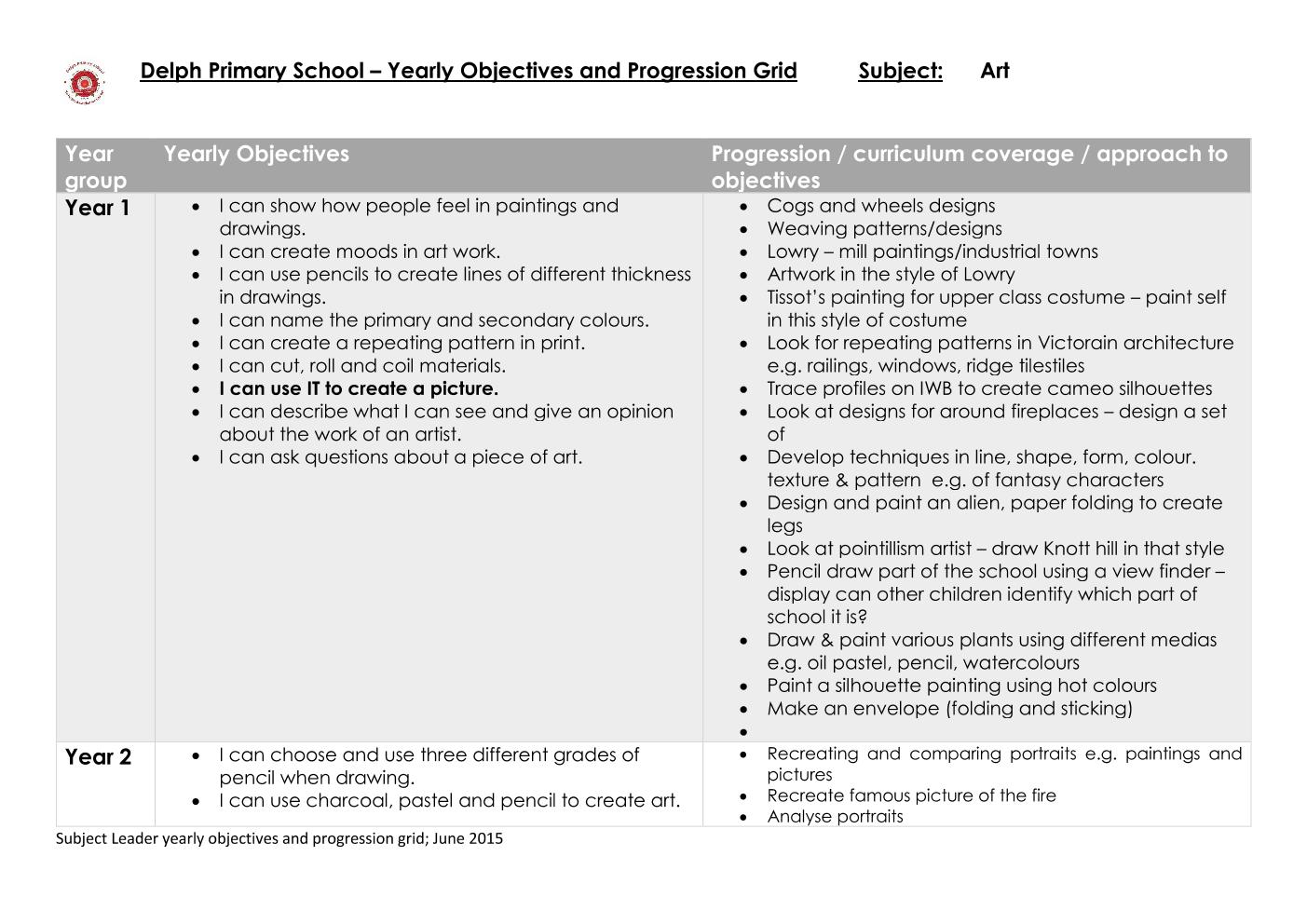
Art Progression Grid

Sticky Knowledge
Sticky knowledge is the interesting facts and knowledge children need to know in this subject.
Art and Design Learning Resources
Please use the links below to visit our Learning Zone.
 |
KS2 Art and Design Resources |