
Modern Foreign Languages
 |
The National Curriculum KS2 Modern Foreign Language |
Our Modern Foreign Languages Curriculum
Intent
Delph Primary School believes all children should receive a high quality, accurate and engaging education within MFL, particularly French to enable them to develop their love of learning about other languages and cultures and help provide them with an understanding of the world. We aim to build the children’s ‘cultural capital’ so that they have a knowledge and understanding of the richness and diversity between cultures. We aim to develop a natural curiosity and confidence to explore, other countries, cultures and languages, accepting that, in a multi-lingual society it is a valuable skill to be able to communicate effectively with others in another language. They will be engaged and prepared to continue language learning at Secondary School. They will recognise the importance of developing their skills and fluency in speaking with the correct pronunciation and intonation. Ultimately, all pupils at Delph will be expected to achieve their full potential in their foreign language learning – so they feel confident engaging in spoken French, develop skills in reading, listening and writing, and know how important languages will be in their future. We aim for all pupils to develop a genuine interest and curiosity about languages, finding them enjoyable and exciting and show a desire to continue their language learning past KS2. We believe that learning another language gives children a new and broader perspective of the world, encouraging them to understand their own cultures and those of others.
Implementation
Our curriculum ensures pupils listen attentively to spoken language and show understanding by joining in and responding. They explore the patterns and sounds of language through songs and rhymes and link the spelling, sound and meaning of words, engaging in conversations, asking and answering questions, expressing opinions and responding to those of others and seeking clarification and help where necessary.
Our aim is for children to speak in sentences, using familiar vocabulary, phrases and basic language structures and develop accurate pronunciation and intonation so that others understand when they are reading aloud or using familiar words and phrases. We aim to present ideas and information orally to a range of audiences, read carefully and show understanding of words, phrases and simple writing and appreciate stories, songs, poems and rhymes in the language to help broaden their vocabulary and develop their ability to understand new words that are introduced into familiar written material. This can include using a dictionary, writing phrases from memory, and adapting these to create new sentences.
We want the children to express their ideas clearly, being able to describe people, places, things and actions orally and in writing and understand basic grammar appropriate to the language being studied, including (where relevant): feminine, masculine and neuter forms and the conjugation of high-frequency verbs; key features and patterns of the language; how to apply these, for instance, to build sentences; and how these differ from or are similar to English. Evidence of lessons taught are captured in children’s French books (either photos, drawings, sentences, captions etc.)
Impact
The MFL curriculum at Delph ensures that all pupils develop key language learning skills as set out by the National Curriculum, as well as a love and curiosity about languages and learning about different places and cultures across the world. Through the input of the Subject Lead and Delph’s monitoring and evaluation cycle, the subject is reviewed and analysed to ensure outcomes are valid and appropriate to the children’s MFL needs and that MFL teaching is monitored for its effectiveness. The Subject Lead ensures staff training is appropriate, accessible and timely to ensure current and emerging needs are met. French is delivered through immersion into the French language from the start of school in EYFS, using French on a daily basis and recognising what is understood, what needs clarification and then observing the children building their confidence, initially in spoken French and then developing to reading and writing, using a more extensive and detailed vocabulary with developing levels of grammar as they progress through the key stages. Through the Subject lead monitoring process we observe teaching and pupils responses, we look at examples of work, planning and offer subject specific staff training delivered by either French teaching experts or subject lead teachers to ensure correct pronunciation and overall teacher confidence in delivering the MFL curriculum. This enables a more accurate detailed teacher assessment both within weekly lessons and end of year/key stage teacher assessments. Assessment within KS2 is linked directly to the objectives of the National Curriculum - see National Curriculum - Languages key stages 1 to 2 (publishing.service.gov.uk).

|
French Policy | [pdf 434KB] |

|

MFL (French) Progression Grid
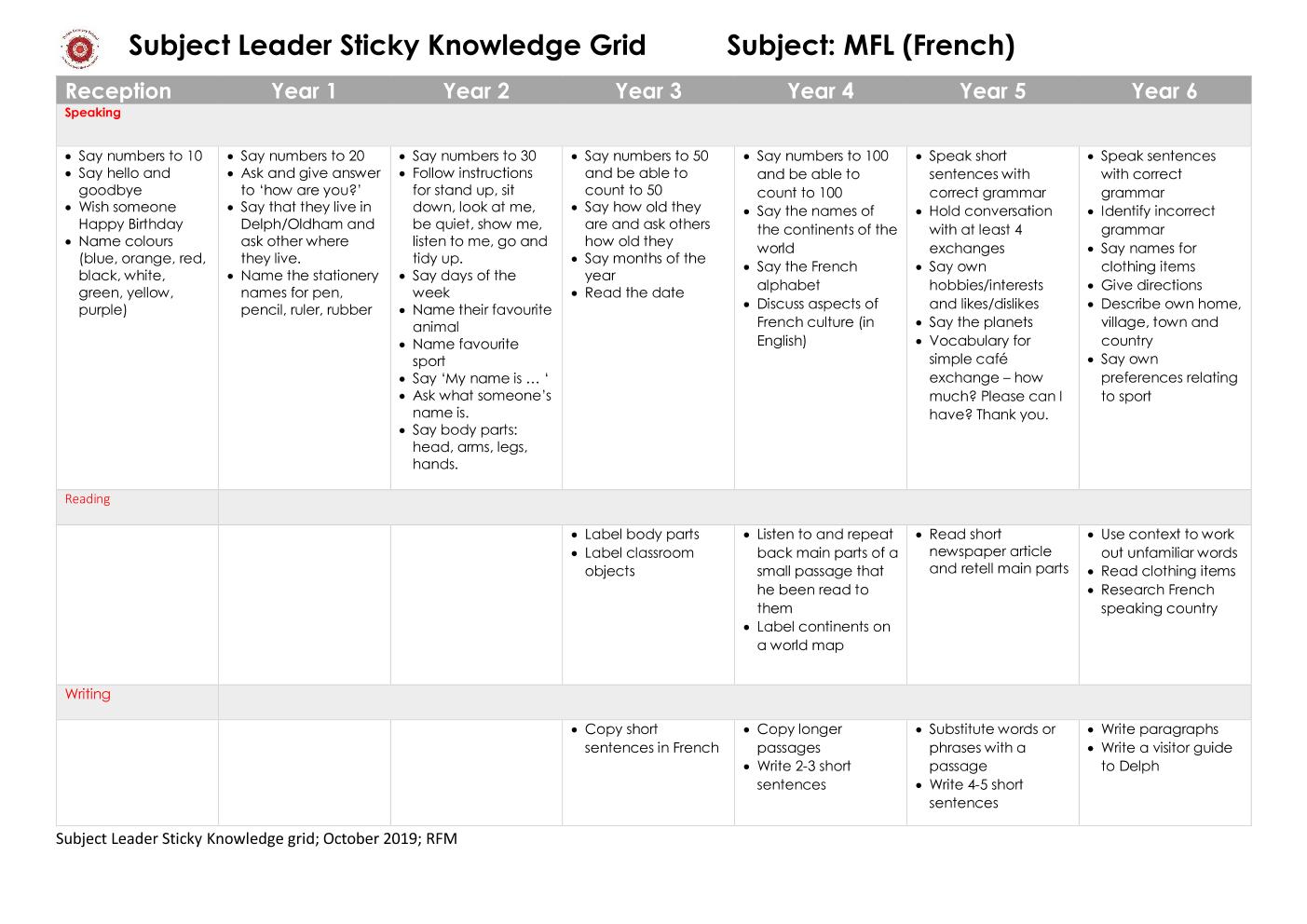
Sticky Knowledge
Sticky knowledge is the interesting facts and knowledge children need to know in this subject.

MFL Learning Resources
Please use the links below to visit our Learning Zone.
|
KS1 Learning Resources |
|
KS2 Learning Resources |