


Our Religious Education Curriculum
Intent
In line with the Oldham Agreed Syllabus for Religious Education our intention at Delph School is to:
- consider challenging questions of meaning and purpose of life, beliefs about God, the self and the nature of reality, issues of right and wrong and what it means to be human;
- understand the influence of religion on individuals, families, communities and cultures;
- learn from different religions, beliefs, values and traditions while exploring questions of meaning and their own beliefs;
- learn about religious and ethical teaching, enabling them to make reasoned and informed responses to religious, moral and social issues;
- develop their sense of identity and belonging, preparing them for life as citizens in a plural, global society;
- develop respect for and sensitivity to others, in particular those whose faiths and beliefs are different from their own.
Implementation
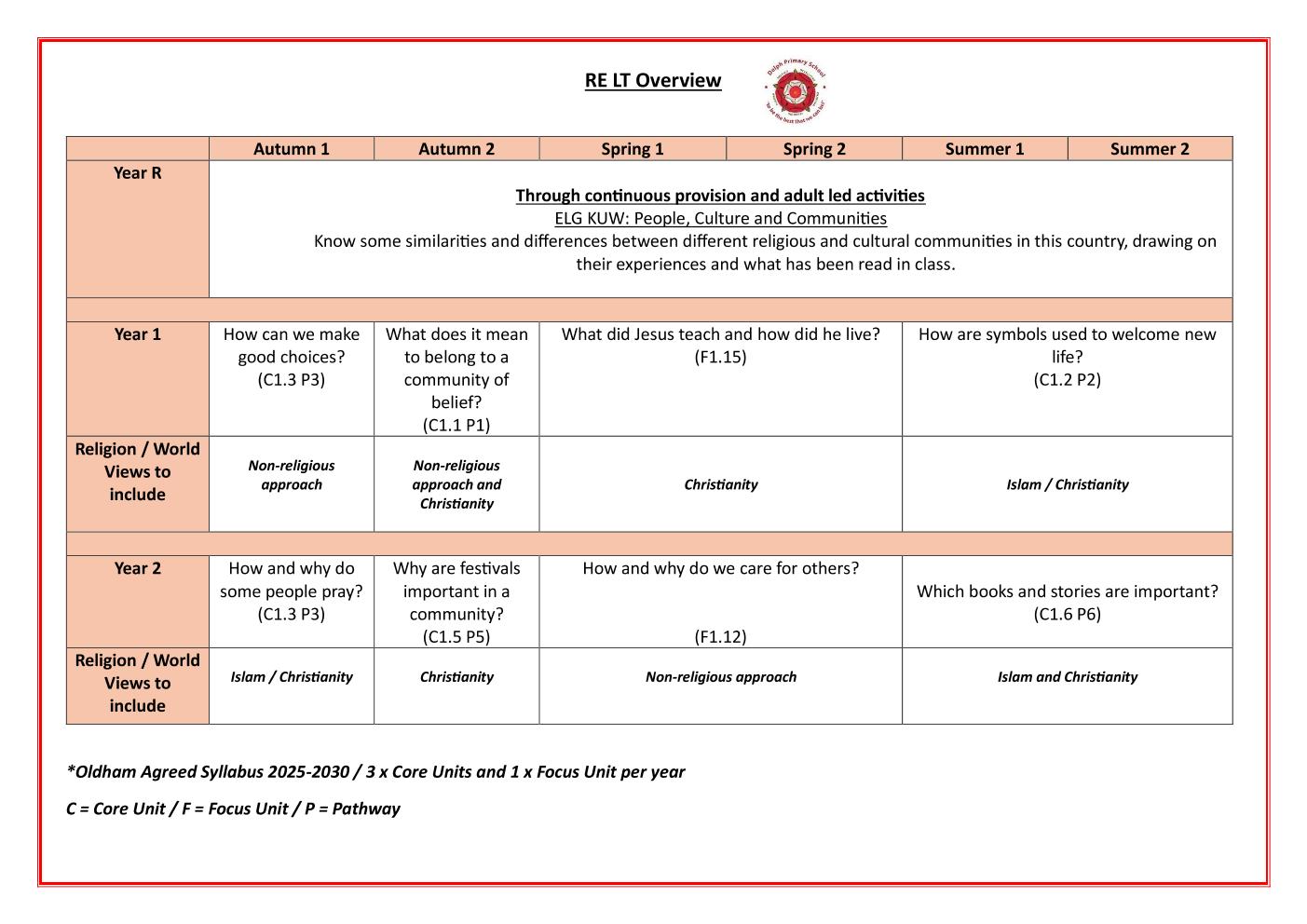
At Delph Primary School Religious Education is a component of the basic curriculum taught alongside the National Curriculum. The law states that the curriculum for every maintained school in England shall comprise a basic curriculum which includes the provision for RE for all registered pupils at the school.
- RE is a core subject of the curriculum for all pupils at Delph.
- RE is different from assembly.
- Curriculum time for Religious Education is distinct from the time spent on collective worship or school assembly.
- At times there is additional delivery of RE through educational visits and celebrations.
- RE is taught through timetabled lesson in clearly identifiable time. This is distinct from other subjects such as English, citizenship or PSHE.
The Oldham Agreed Syllabus is designed for pupils to experience coherence and progression within the RE scheme of work.
Impact
By teaching RE at Delph our aims are threefold linked to the aims of the Oldham Agreed Syllabus:
Children will be able to make sense of a range of religious and non-religious beliefs, so that they can:
- identify, describe, explain and analyse beliefs and concepts in the context of living religions, using appropriate vocabulary;
- explain how and why these beliefs are understood in different ways, by individuals and within communities;
- recognise how and why sources of authority like religious text, traditions and leaders are used, expressed and interpreted in different ways.
Understand the impact and significance of religious and non-religious beliefs, so that they can:
- examine and explain how and why people express their beliefs in diverse ways;
- recognise and account for ways in which people put their beliefs into action in diverse ways, in their everyday lives, within their communities and in the wider world;
- appreciate the significance of different ways of life and ways of expressing meaning.
Make connections between religious and non-religious beliefs, practices and ideas.
Religious Education Learning Resources
Please use the links below to visit our Learning Zone.
 |
KS1 Religious Education Resources |
|
KS2 Religious Education Resources |